The DeMicco Digest
For each post, I use Google NotebookLM to create a podcast-style conversation between two AI hosts. I don’t script or edit their discussion, so it’s their interpretation of the article and a glimpse into what AI can do. The written post reflects my own views. How I use AI on this site
The drone shots are beautiful. The music swells. The founder’s grandson talks about values. The engineer who actually specifies your product closed the tab after eleven seconds, because she wanted to see the product.
I have watched a lot of industrial brand videos (and made a few as well), and I have watched a lot of owners watch them. The reaction in the conference room is always the same. The owner is moved. The sales team is proud. Someone says it should go on the homepage. It does, and for the next two years it plays on the trade-show loop while a very specific person, the one the company actually needs to reach, scrolls past it looking for a spec sheet.
This is not an argument against brand video. It is an argument about audience, and about which of two very different videos a company should make first when the budget only stretches to one. Most industrial companies make the wrong one first and then wonder why the beautiful thing they paid for produced no inquiries.
Table Of Contents
Above deck and below deck
A useful way to think about industrial video borrows from ships. Above deck is where the company presents itself to the world: who we are, how long we have been here, what we believe. Below deck is where the work happens: the product, the process, the tolerances, the test rig, the install. Above-deck video is about the company. Below-deck video is about the buyer’s problem.
Above-deck video has real jobs. It welcomes a visitor who has never heard of you. It loops on a trade-show monitor. It helps a recruiter. It gives a new distributor something to show. Those are worth doing, and they are worth doing well. What above-deck video does not do is answer the question a specifier brings to your website at 4:30 on a Thursday, which is some version of: will this thing work in my application, and can I trust these people to deliver it on time?
That question is answered below deck, and almost nobody makes that video, because it is not the one that moves the owner in the conference room.
Why companies keep making the wrong one
Three reasons, and none of them is stupidity.
The people who commission video respond to emotion
Owners and marketing leaders often approve the budget, and they are human. A treatment that opens with the founder’s photograph and closes with the third generation walking the floor persuades the person whose family that is. Though it may speak to longevity and trust in continuity, it may not persuade a maintenance engineer at a plant four states away who needs a replacement part before the next shutdown window.
The people who make video are trained to make that one
Production companies are, by and large, storytellers. They are very good at it. A technical walk-through with an engineer explaining a pressure rating over a bench test is not what they went to film school for, and it is not what fills their reel. Left to their own instincts, they will make the video they know how to make, and it will be lovely.
Video gets measured by the wrong number
Views. Views reward the emotional piece, which gets shared by employees and friends and industry acquaintances, none of whom are buying. The technical piece gets a tenth of the views, from exactly the people who matter, and gets judged a disappointment because nobody was measuring the right thing.
What the buyer research says
There is a long-running study I find useful here even though it covers a different sector. TrustRadius has surveyed business technology buyers annually since 2017 on which information sources they use and trust. Across the editions I have read, the same pattern holds: product demonstrations rank among the most consulted and most helpful resources, and vendor marketing collateral ranks among the least trusted. In the 2023 edition, product demos were the single most consulted resource. Buyers, when asked in their own words, said they valued demonstrations that were realistic, specific to their situation, and let them see how the product actually behaved.
Those are software buyers, and I will not pretend a bearing specifier and a software buyer are the same person. But I have never met an industrial buyer who wanted less evidence than a software buyer, and the underlying instinct is universal: show me the thing working in conditions that look like mine, and let me hear from someone who knows it. Gartner’s research on the broader B2B buying journey adds the reason this matters more now than it used to. Buyers spend only about 17 percent of a purchase process talking to suppliers at all. The rest is research they do on their own, and video is one of the few ways your engineer can be in the room when you are not.
What a below-deck video actually contains
Before the checklist, the question of where the content comes from, because this is the step that makes the whole thing doable for a marketing manager who has never briefed a video. The material is already in the building. It is the ten questions your sales team answers on every call, the back-and-forth in the last twenty quote requests, the things customer service explains twice a week. Write those down, in the buyer’s words, and you have the brief. The video is a recorded answer to a question you already know is being asked. It is not a creative exercise. It is closer to transcription.
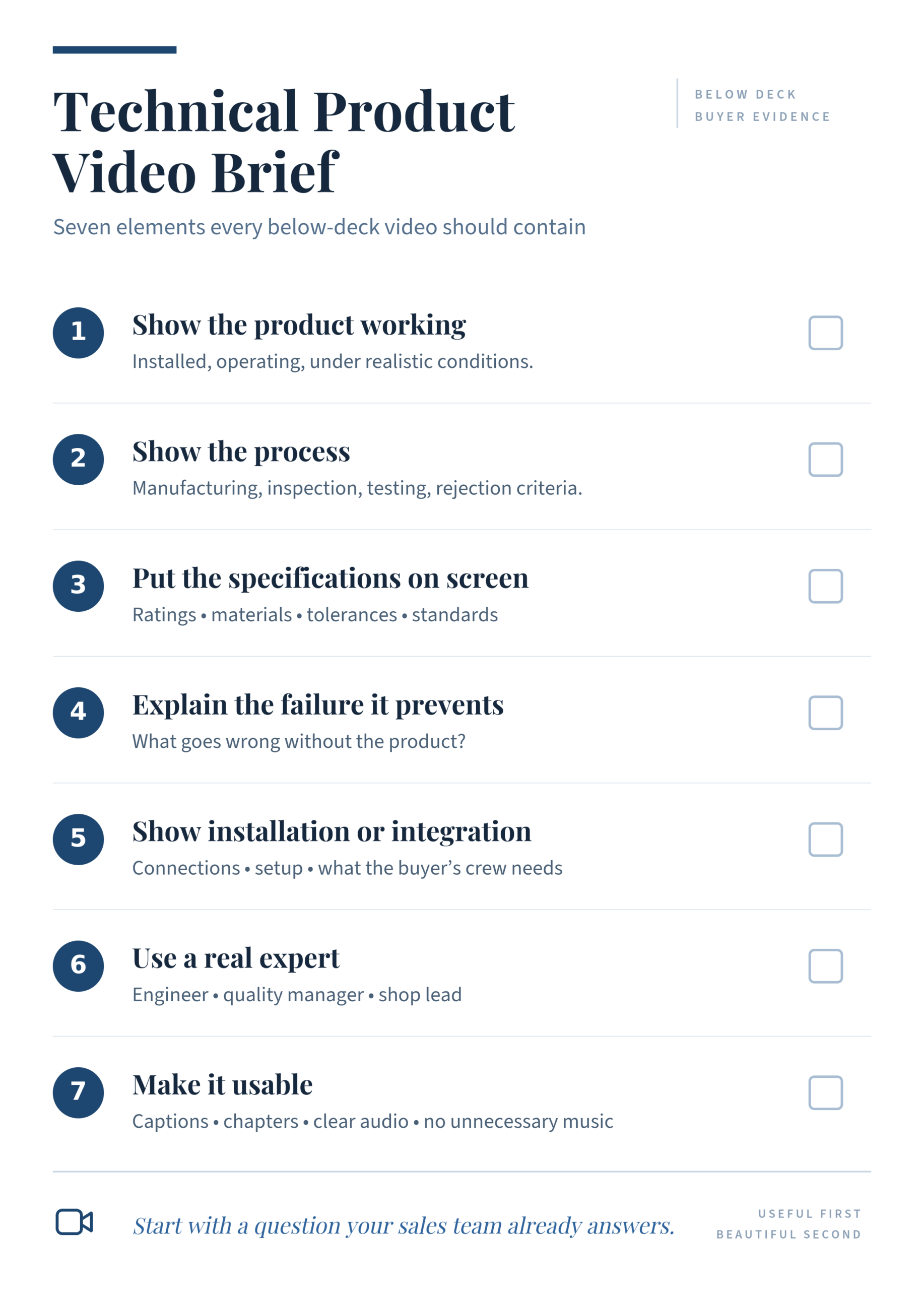
With that in hand, here is what the video contains, as a checklist you can hand to whoever is holding the camera.
- The product doing its job. Not sitting on a white background. Installed, running, under load, in an environment that looks like the buyer’s.
- The process. How it is made, what gets inspected, what gets rejected. The test rig, the calibration, the person with the calipers. Industrial buyers trust what they can see being checked.
- The specification, on screen. Ratings, materials, tolerances, standards met. As text overlays and, later, as chapters, so a viewer can jump to the number they came for.
- The failure it prevents. Every industrial product exists because something goes wrong without it. Show that, or describe it plainly. It is the most persuasive minute you can film.
- Installation or integration. What it takes to put it in, what it connects to, what the buyer’s crew will need. This is where the maintenance engineer decides.
- A person who knows. Your engineer, your quality manager, your shop lead. Not an actor, not a voiceover. A slightly awkward expert beats a polished narrator every time in this sector, because the buyer is an expert too and can tell.
- No music bed, captions on, chapters marked. The video will be watched on a plant floor with the sound off, on a phone, by someone looking for one thing.
Length is whatever the content needs, which is usually three to eight minutes. Few people skip a useful video because it is long. They skip a useless one because it is.
Where it lives, and what it does there
The below-deck video’s home is the product page, above the fold, next to the specifications. From there it goes into the quote follow-up email, the sales deck, the distributor portal, and the company’s video channel with chapters and a full transcript. The transcript matters more than most people realize: it is what search engines and AI answer engines index, and a technical video with a good transcript and proper video markup is a page that can be cited when a buyer asks an answer engine a very specific question. I wrote in March about the infrastructure behind that. Video is one of the assets it applies to.
The sales use is the one that pays fastest. A rep who can answer “does this handle our temperature range” with a link to a two-minute segment of the engineer demonstrating exactly that has shortened the conversation by a week. I have written about speed to lead as a process problem; a library of below-deck video is one of the few tools that makes fast follow-up substantive rather than merely fast.
The sequence, if you can afford both
- Make the below-deck video first. It sells. Start with the product line that carries the most revenue or the most technical questions, whichever produces more sales conversations.
- Cut the above-deck video short. Sixty to ninety seconds. It earns attention on LinkedIn and on the trade-show loop; it does not need to carry the whole story, because the technical video is now doing that.
- Link them in that order. The brand piece ends by pointing at the technical library. The technical piece does not need to point anywhere except the quote form.
- Measure the technical video by use, not views. Watch-through rate, how often sales sends it, inquiries from pages that carry it. If those numbers are moving, the video is working, whatever the view count says.
- Build the library one product at a time. A dozen focused videos over a year beats one production that tries to cover everything.
A word on production cost
Below-deck video does not need the budget above-deck video needs. A steady phone on a tripod, decent light, a lapel microphone, and an engineer who knows the product will produce something a specifier trusts more than a crane shot. The expensive part is the thinking: which questions the buyer actually asks, which product to start with, and what to put on screen. That is a marketing job, and it is the part most companies skip on their way to hiring the drone.
The objection I hear most is that the engineers will not go on camera. They do not have to. Hands and a voice over the bench, showing the part and explaining the test, is enough, and the maintenance engineer watching on the other end trusts it more than a face anyway, because it looks like their own shop. Start there. Reluctance tends to fade the first time a customer quotes the video back to the person who made it.
Make the beautiful video if you want to. Just make the useful one first, and give it to the person who signs the order.
Sources & Further Reading
The following resources informed this article. All claims have been verified against multiple sources where possible.
- TrustRadius, “The B2B Buying Disconnect” (annual report; 2017 through 2023 editions) – https://www.trustradius.com/vendor-blog/b2b-buying-disconnect
- Gartner, “The B2B Buying Journey” – https://www.gartner.com/en/sales/insights/b2b-buying-journey
- Google Search Central, “Video structured data – https://developers.google.com/search/docs/appearance/structured-data/video
Joe DeMicco is the Founder and President of Amplify Industrial Marketing + Guidance (AIMG), a full-service B2B industrial marketing agency with 30+ years serving manufacturers, fabricators, distributors, and trade associations. He is also the founder of Industrial Web Search (IWS), a keyword-driven B2B supplier directory platform. Joe teaches the marketing module for the Goldman Sachs 10,000 Small Businesses program and writes about AI, marketing, and B2B strategy at demicco.com.