The DeMicco Digest
Grab your headphones and enjoy a mini-podcast version of this blog. Sit back and listen while we walk you through the key points!
AWS just launched its first business-category certification. Here is what its blueprint reveals about who should be deciding your AI spend, and why most companies have the wrong person in that seat.
For thirty years the most valuable person in an industrial company’s technology decisions has rarely been the one who could build the thing. It has been the one who could tell you whether the thing was worth building. That role has never had a name, a job description, or a credential. As of September 1, it has at least one of the three.
Earlier this year I was invited to serve on the panel of subject matter experts who helped AWS develop its first AI Business Strategist certification, exam code AIB-C01. The exam opened for beta registration on September 1, and I have been asked about it more in the past week than about anything else I have worked on this year.
Let me set expectations before going further. I signed a confidentiality agreement with AWS, and I take it seriously. Nothing in this article comes from inside the development process. Everything here is drawn from the exam guide AWS has published and from the announcement on the AWS Training and Certification blog. What I can add is thirty-plus years of watching industrial companies make technology decisions, and a view on why a company that sells cloud infrastructure decided that a credential with no infrastructure in it was worth building.
Table Of Contents
Why a cloud company built a certification with no cloud in it
AWS has been certifying engineers for more than a decade. Solutions architects, developers, machine learning engineers, security specialists. Every one of those credentials validates the ability to build something. The new certification is the first one that validates the ability to decide something.
In its announcement, AWS framed it plainly: every AI initiative has two kinds of work happening at once. There is the building, which is the models, the infrastructure, and the code. Then there is the deciding, which is which investments to fund, how to measure success, what governance belongs in place, and when to scale or stop. AWS has credentialed the builders for years. This credential is for the deciders.
The reason they built it is the reason you should care. AWS pointed to research showing that 88 percent of organizations now use AI in at least one business function, while only 19 percent report that those efforts are producing meaningful business outcomes. It also cited a Harvard Business Review study finding that middle managers are carrying the operational weight of AI adoption, making decisions about usage standards, quality, and governance in isolation, without firm-wide guidance. AWS calls the result “pilot purgatory,” and the diagnosis is structural: most organizations bolted AI onto existing workflows without redesigning the work itself.
I have watched this cycle before. In the mid-1990s every company was told to get a website. A small number of them stopped to ask what the website was for, who it served, and how they would know whether it was working. Those companies won the next decade. The rest bought a brochure that lived on a server. The split we are watching now is the same split, with a more expensive tool.
What the exam actually measures
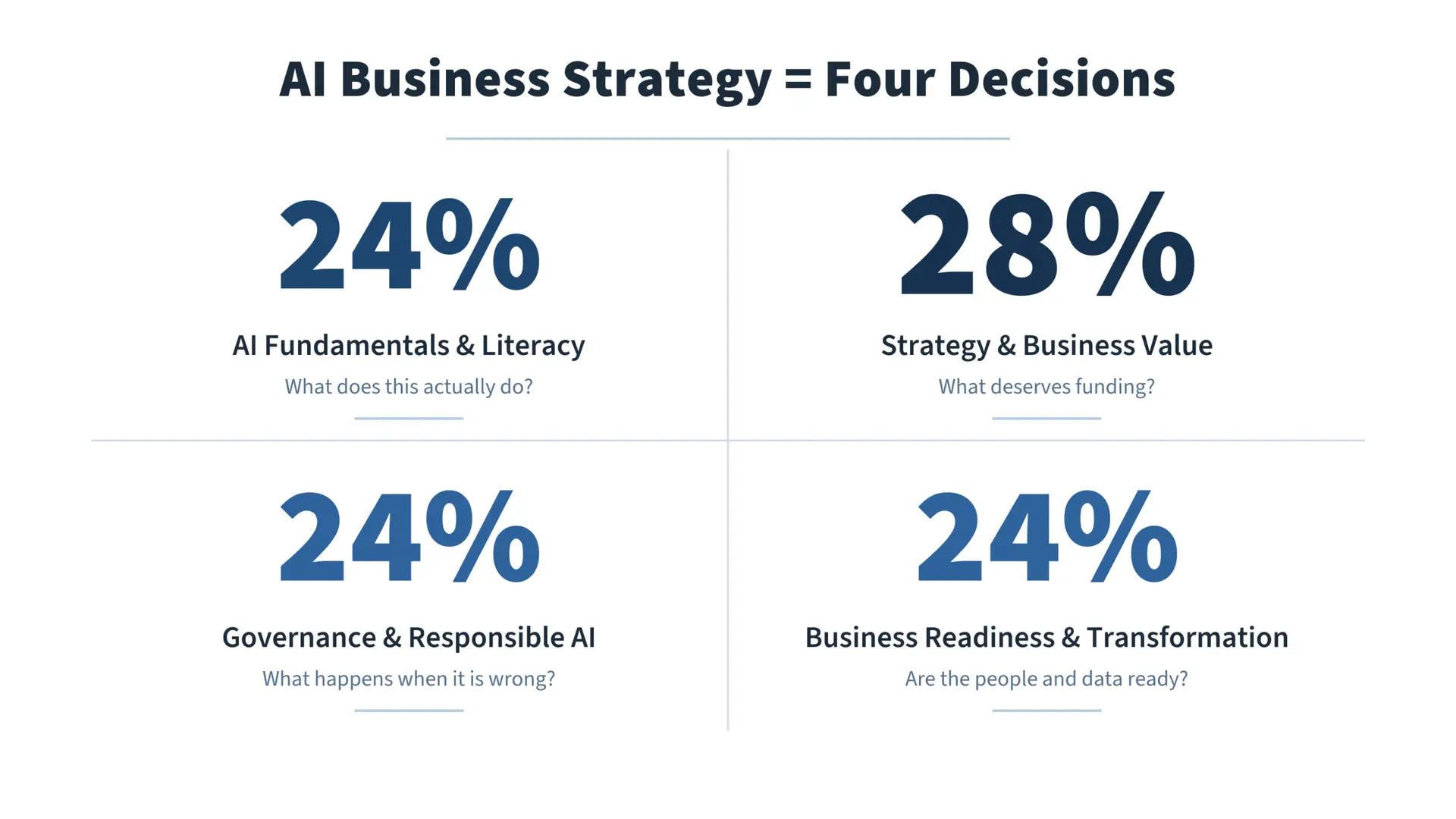
The published exam guide breaks the certification into four content domains. The weightings below are from the guide itself. What I have added is the question each domain asks when you translate it into the language of a manufacturer, fabricator, or distributor.
Domain | Weight | What it sounds like inside an industrial company |
|---|---|---|
1. AI Fundamentals and Literacy | 24% | Can you explain what the tool actually does without hiding behind vendor language? Do you know when a plain rule would work better than a model? |
2. AI Strategy and Business Value Creation | 28% | Which three projects deserve funding, which one should be killed, and what was the baseline number before we started? |
3. AI Governance and Responsible AI Leadership | 24% | What happens when the system is wrong? Who catches it, who escalates, and what data are we exposing along the way? |
4. Business Readiness, Leadership, and AI Transformation | 24% | Is our data usable? Who owns it? Is leadership actually sponsoring this, or just approving a line item? |
Three things in that blueprint stand out to me, because they are the three things I spend most of my client conversations on.
The exam tests knowing when AI is the wrong answer
Domain 2 is the largest domain, and the guide states that recognizing when AI is not the right solution is explicitly tested. Domain 1 goes further and covers the deliberate skill of choosing rule-based automation over AI when a rule is the better tool. I cannot overstate how important that is. When a quoting process fails because two spreadsheets disagree, the fix is a rule, not a model. When a lead sits for four days because nobody was assigned to it, the fix is a workflow, not an agent. A certification that rewards the person who says “we do not need AI for this” is a certification built by people who have watched money get wasted.
Baselines come before deployment, not after
The measurement material in Domain 2 requires that baseline metrics be established before an AI system is deployed, so that its effect can be accurately attributed. I have lost count of the industrial companies that installed a tool, saw activity increase, and declared victory without ever having recorded what the number was the month before. Attribution is not a nice-to-have. It is the difference between a strategy and a guess, and it is the exact reason budgets get cut the following year when a CFO asks a simple question nobody can answer.
Data ownership is a leadership problem, not an IT problem
Domain 4 covers data readiness, accessibility, the impact of silos, and the roles of data strategy and ownership. This is the domain I expect most candidates from mid-market companies to find uncomfortable, because it names the thing nobody in the building wants to own. Almost every CRM migration I have been involved with this year was blocked by the same discovery: duplicate records, unreliable fields, and no single person accountable for the quality of the data. AI does not fix that. AI amplifies it. Until someone owns the data, every AI investment downstream of it is built on sand.
Five questions to ask before funding any AI project
If you take the four domains and compress them into what an owner or a CEO should actually ask when a proposal lands on the desk, you get five questions. I have started using these in client planning sessions, and they are doing more work than any vendor demo.
- What is the baseline? What is the number today, measured the same way we intend to measure it afterward? If nobody can answer, the project is not ready to fund.
- Would a rule do this? If the problem can be solved with a workflow, a form, or a policy, solve it that way first. AI is for judgment under ambiguity, not for enforcing a decision you have already made.
- Who owns the data this depends on? Name the person. If the answer is a department, the answer is nobody.
- What happens when it is wrong? Every AI system will produce a bad output eventually. Who sees it first, what triggers escalation, and what is the cost of the mistake reaching a customer?
- What does “stop” look like? Before launch, define the conditions under which the project gets paused or terminated. Projects that lack an exit criterion become permanent line items.
Who should actually take this exam
I want to be honest about what this credential is and what it is not. It is a foundational-level, business-category certification. Passing it will not make anyone a strategist. What it validates is a way of thinking about AI decisions, and it gives an organization a shared vocabulary for making them. That is valuable. It is also limited. A credential on a resume is not a track record, and I would not hire a strategist on the strength of one.
The right candidate is the person in your company who says yes or no to software spend and does not write code. That might be an owner, a general manager, a vice president of sales evaluating an AI prospecting tool, or a marketing lead being pitched an AI content platform. It is not your IT person or your developer. AWS has a separate credential, AI Practitioner, for technical foundations, and the two are designed to complement each other.
The practical details, all from AWS’s published materials: the standard price for a Business-category exam is $100, and AWS offers beta exams at a discount from that price (the beta was listed at $50 at the time of writing). The standard exam is 130 minutes; a beta sitting contains more questions than the standard version, so plan for a longer session. Scoring is on a 100 to 1,000 scale with a passing mark of 700. Exam delivery begins September 29 through Pearson VUE, in a test center or online proctored, in English or Japanese. Anyone who earns the certification by February 15, 2027 also receives an Early Adopter badge.
Two things to know before choosing the beta. AWS beta exams are available for a limited window, generally one to three months, and a candidate can take the beta only once; a retake means waiting for the standard version. Results follow the same five-business-day policy as any AWS exam, and a beta pass earns the full certification, active for three years. If you want a low-cost way to pressure-test your own AI judgment, the beta is a reasonable bet. If you are not confident you will pass on the first attempt, wait for general availability.
Why I said yes
When AWS asked me to participate, my first reaction was that I am a marketer, not a technologist. That turned out to be the point. The credential is aimed at people who make and advise on AI investment decisions, not people who build the systems, and AWS wanted that perspective represented in the room. The role AWS was trying to define is the role I have been playing informally for clients for years: the person in the room whose job is to say what not to buy.
I have written before that AI is an amplifier, not a shortcut. This certification is the first credential I have seen that takes that position seriously enough to test it. The building is getting cheaper every quarter. The deciding is not.
If you are an industrial leader trying to figure out which of your AI ideas deserve budget in 2027, the four domains above are a better planning framework than anything a vendor will hand you. Start with the five questions. If you get stuck on question three, you are in good company. Most companies do, and it is the one worth solving first.
Sources & Further Reading
The following resources informed this article. All claims have been verified against multiple sources where possible.
- AWS Certified AI Business Strategist exam guide (AIB-C01) – https://docs.aws.amazon.com/aws-certification/latest/ai-business-strategist-01/ai-business-strategist-01.html
- AWS Training and Certification blog, Sept 1 2026 – https://aws.amazon.com/blogs/training-and-certification/introducing-aws-certified-ai-business-strategist-built-for-the-people-who-scale-ai/
- AWS certification page – https://aws.amazon.com/certification/certified-ai-business-strategist/
- AWS Certification before-testing policies – https://aws.amazon.com/certification/policies/before-testing/
- McKinsey, The State of AI (2025), as cited by AWS – https://www.mckinsey.com/capabilities/quantumblack/our-insights/the-state-of-ai
- ServiceNow / Oxford Economics, Enterprise AI Maturity Index (2025), as cited by AWS – https://www.servicenow.com/workflow/ai/enterprise-ai-maturity-index-2025.html
Joe DeMicco is the Founder and President of Amplify Industrial Marketing + Guidance (AIMG), a full-service B2B industrial marketing agency with 30+ years serving manufacturers, fabricators, distributors, and trade associations. He is also the founder of Industrial Web Search (IWS), a keyword-driven B2B supplier directory platform. Joe teaches the marketing module for the Goldman Sachs 10,000 Small Businesses program and writes about AI, marketing, and B2B strategy at demicco.com.
FAQ
What is the AWS Certified AI Business Strategist certification?
Do you need coding or AWS experience to take it?
How is it different from AWS Certified AI Practitioner?
How much does the exam cost and how long is it?
The standard price for an AWS Business-category exam is $100, and beta exams are offered at a discount (listed at $50 at the time of writing). The standard exam is 130 minutes; the beta sitting contains more questions and runs longer. Results are reported on a 100 to 1,000 scale with a minimum passing score of 700.