The DeMicco Digest
For each post, I use Google NotebookLM to create a podcast-style conversation between two AI hosts. I don’t script or edit their discussion, so it’s their interpretation of the article and a glimpse into what AI can do. The written post reflects my own views. How I use AI on this site
For most of my career, “search” has meant one thing in most people’s minds: Google.
Maybe Bing, maybe DuckDuckGo, etc, but always the same mental model. You type a few words, and the web organizes itself around your query.
That model is collapsing, quietly, but fast.
In 2025, I started noticing something that reminded me of the late-1990s web all over again: a gold rush. But this time it’s for context, instead of domain names or banner ad space. Every major AI company is now positioning itself as the next gateway to knowledge. OpenAI now has Atlas, Perplexity with Comet, and I’m sure Anthropic will surprise us soon – each one is teaching us that search is no longer about “finding.” It’s about understanding.
The Moment It Hit Me
I’ve been experimenting with these new AI browsers and search tools for a while.
Perplexity impressed me early on because of its built-in citations. As a researcher and business owner, I could instantly verify what I was reading. When Perplexity launched Comet early this month (October 2, 2025), I jumped in and loved how it handled contextual follow-ups.
But the real lightbulb moment came when I opened Atlas this week.
I typed a query for one of my client’s key product categories-something highly specific in the industrial market-and there was their website, cited right there in the response. Impressive enough.
Then, on that same client’s site, I asked Atlas whether they carried a particular manufacturer.
Instantly, in the right-hand toolbar, it confirmed yes, and went further. It broke out product family groupings, explained each one succinctly, and even gave me the option to navigate directly to the correct page.
Then I said out loud: “Can you take me there?”
…And it did.
That’s not “search” anymore. That’s conversation fused with action – and it changes everything about how we need to think about the content we put online.
What Most Business Leaders Miss
When people think of “search,” they still picture ten blue links. But that world is fading.
Today, AI engines are reading your site differently. They’re not looking at keywords – they’re looking at meaning, relationships, and structure.
If your website doesn’t clearly state what you offer, how you describe it, and who it’s for – not just for people, but in language machines can also interpret – you risk becoming “left out” of the consideration phase in the very systems your customers are now using to find information.
This isn’t an SEO fad.
It’s an evolution from search optimization to context optimization.
The New Search Economy
I think I’ve made my point that the new AI browsers and engines aren’t “search engines” in the traditional sense. They’re answer engines, contextually aware systems that synthesize, summarize, and often act on your behalf.
| The Old Model | The New Model |
| You search for an answer | The AI creates the answer |
| Ranking signals matter | Relevance and clarity matter |
| Users click through pages | Users talk and get results |
| SEO drives traffic | Structured, credible content drives inclusion |
That means the race is no longer just for page-one visibility (though it’s still important); it’s also for referential credibility.
You’re not just trying to be ranked. You’re trying to be quoted.
The Quiet Winners of 2026
At Amplify Industrial Marketing + Guidance, we’re already seeing this shift play out across clients.
The companies that are winning in these AI search results aren’t necessarily spending more, they’re organizing better.
They’re publishing product data that’s structured, complete, and readable.
They’re answering questions that customers actually ask.
They’re transparent, technical, and specific – all traits AI models love because they can be verified and summarized.
In short, they’re feeding the next generation of search, not fighting it.
What Business Owners Should Be Doing Now
1. Audit Your Website for Clarity
Pretend you’re an AI agent. Can you tell, in seconds, what you sell, what industries you serve, and what makes you credible?
2. Structure Your Data
Proper Schema markup, product attributes, FAQs, downloadable specs – these are now your current lifelines. They help machines understand and classify your content correctly.
3. Be the Source, Not the Summary
Publish original insights, test data, guides, and expertise. AI engines prefer to quote primary sources.
4. Check How You’re Referenced in AI Engines
Search your business in Atlas, Perplexity, and ChatGPT. See what they say. If it’s wrong, fix your website content first. That’s where the AI is getting its context.
5. Build Trust with Transparency
The more verifiable and citation-worthy your content, the more likely you are to be surfaced in AI results.
The Reality Check
There’s risk here too.
AI engines may summarize your content without always giving proper credit (or bury it in references, so the link to your site may go unnoticed).
Visibility will fluctuate as models evolve. And yes – some of this is still a black box.
But the larger truth is unavoidable: these systems are rewriting how discovery happens. Whether you adapt or not, your customers are already using them.
Final Thought: This Is Not the End of Search by any stretch… It’s the Start of Something Bigger
Back in the mid-90s, when we started our first web projects, businesses had to be convinced they even needed a website.
(True Story – Early in my career, I was once thrown out of an office as the owner exclaimed, “The internet will go the way of the buggy whip!” )
Then we had to convince them they needed to be found.
Now, the challenge is to make sure they can be understood.
Search isn’t dying – it’s evolving into something more conversational, more contextual, and far more personal.
And just like before, the businesses that move first – that learn how to be part of this new knowledge layer – will be the ones everyone else is trying to catch.
Be a Bloomer
One of the great books I’ve read recently is Super Agency by Reid Hoffman and Greg Beato. In it, he describes four types of people in how they respond to the rise of AI:
the Doomers: who refuse to see what’s happening as positive;
the Gloomers: who are highly critical of AI but not in line with the pessimism of the Doomers;
the Zoomers: who race ahead without structure or purpose; and
the Bloomers: those who lean in, learn fast, and use technology with intention and discipline.
That’s the mindset every business leader needs right now.
Whether you run a manufacturing company, a marketing agency, or an engineering team, this isn’t a time to hesitate – it’s a time to evolve with purpose. The people and companies that will win in the new search era aren’t the ones chasing every shiny AI feature; they’re the ones building systems that make sense, create value, and stay grounded in serving real customers.
The next era of search – and business growth – will belong to the Bloomers.
Let’s be them!
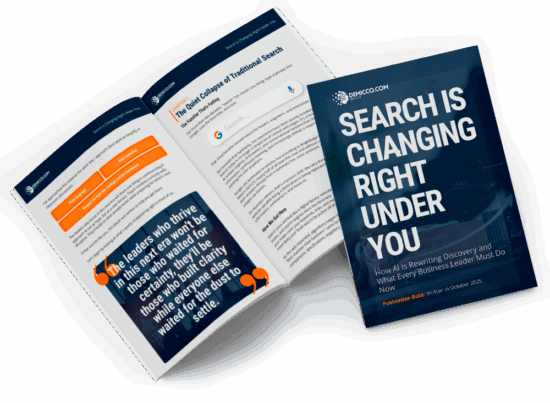
Lead with Clarity in the Age of Intelligent Search
Because your role isn’t to chase algorithms; it’s to lead your organization with clarity and confidence.
Joseph DeMicco brings over 30 years of experience to his roles as founder and CEO of Amplify Industrial Marketing + Guidance, founder of Industrial Web Search, and instructor for the Goldman Sachs 10,000 Small Businesses program, specializing in data-driven marketing strategies.