For each post, I use Google NotebookLM to create a podcast-style conversation between two AI hosts. I don’t script or edit their discussion, so it’s their interpretation of the article and a glimpse into what AI can do. The written post reflects my own views. How I use AI on this site
Over the past year, I’ve noticed a pattern that feels familiar, but this time it’s moving much faster than I have seen before, and the stakes are much higher..
Back in the early days of the World Wide Web (once bandwidth opened up a bit), businesses rushed to adopt whatever new plugin, widget, or tool promised an edge. Some of those solutions stuck, but many overlapped, conflicted, or disappeared, leaving companies with scattered data and systems and often with no real applicable knowledge as a return on their investment.
I believe we’re entering a similar era with AI.
The difference? This time it’s on steroids.
The Vendor Gold Rush
It seems every major platform is racing to add AI “enhancements” to its current offerings, which absolutely makes sense.
- HubSpot is rolling out AI assistants for marketing and sales.
- Search vendors are embedding AI to re-rank results semantically and better handle non-normalized content.
- Chat platforms are deploying conversational agents that crawl your website content.
- Specialized plugins promise personalization, recommendations, and customer support powered by LLMs.
All good stuff, and individually, these tools can add great value to their existing utility.
The challenge is how that looks a few years out in terms of aggregate value. If not well-planned and considered, collectively, they may easily create a sprawling ecosystem of AI “plugged in” to your systems.
The result?
Businesses risk having three, four, or even more “AI brains” on a single site pulling from different datasets, trained differently, and reporting results in separate dashboards.
Every vendor solution provides some value to you or your customers, but where is your ultimate source of truth when assessing impact on your goals, your users, business intelligence gathered, or ROI?
The Mutual Fund vs. The Individual Planner
Here’s the analogy I keep coming back to:
Buying into a vendor’s AI ecosystem is like investing in a mutual fund. You’re getting access to a pre-packaged set of assets managed by someone else. It’s convenient, easier to get in, and can deliver decent returns – but you don’t get to choose the underlying holdings.
On the other hand, building (or curating) your own AI strategy is like working with a skilled financial planner. You can tailor exactly which assets to hold, why you have them, and how they’re balanced. It requires more thought upfront, more management, and more attention, but the long-term payoff is alignment with your unique goals.
Neither approach is inherently right or wrong. But if you don’t know which you’re in – or if you’re unknowingly paying into multiple overlapping “funds”- you risk dilution and confusion.
Why “Source of Truth” Matters
At the heart of this is a deceptively simple question: Where does the truth live?
- If HubSpot’s bot answers a question one way, but your AI-powered search tool ranks results on your site differently, who’s right? And more importantly, how do you manage it?
- If a search tool vendor reports one set of user queries and an AI agent logs another, which dataset do you use to inform decisions?
- If your chatbot serves up stale information because no one is governing its training data, how are you alerted and monitoring it compared to what agents your sales or client service team may be using?
Unless companies define their system of record and align AI tools around it with goals and well-established plans to support them, they’re going to end up with competing narratives inside their own websites and systems.
Reality Check: The Vendors Won’t All Play Nice
Here’s the hard truth: most platforms today are not designed to cooperate.
HubSpot, Salesforce, Zendesk, and nearly every “AI-enhanced” tool want to be the system relied upon for their utility. They each may expose some APIs, but not the parts that give you complete visibility.
That’s fine. You don’t have to make them all talk perfectly to each other. The goal isn’t harmony – it’s transparency.
You can still win by:
- Knowing where each tool stores and logs its data.
- Pulling just enough of that information into your own view.
- Accepting partial integration – and planning around it.
In other words, this isn’t about forcing a perfect AI ecosystem. It’s about owning the map even if you don’t control every road.
The Practical Path Forward
So the goal is to make these tools work together under a unified plan around information.
We’re already past the point where any one platform can be the single “source of truth.” Each system serves a different purpose – your CMS manages content, your CRM manages relationships, your ERP manages operations, and your DAM manages assets. None of them, on their own, understands the whole story.
The real goal is to build a knowledge backbone that sits between these systems, one that extracts, harmonizes, and governs the data that AI tools will eventually use to communicate on your behalf.
Here’s an approach to consider:
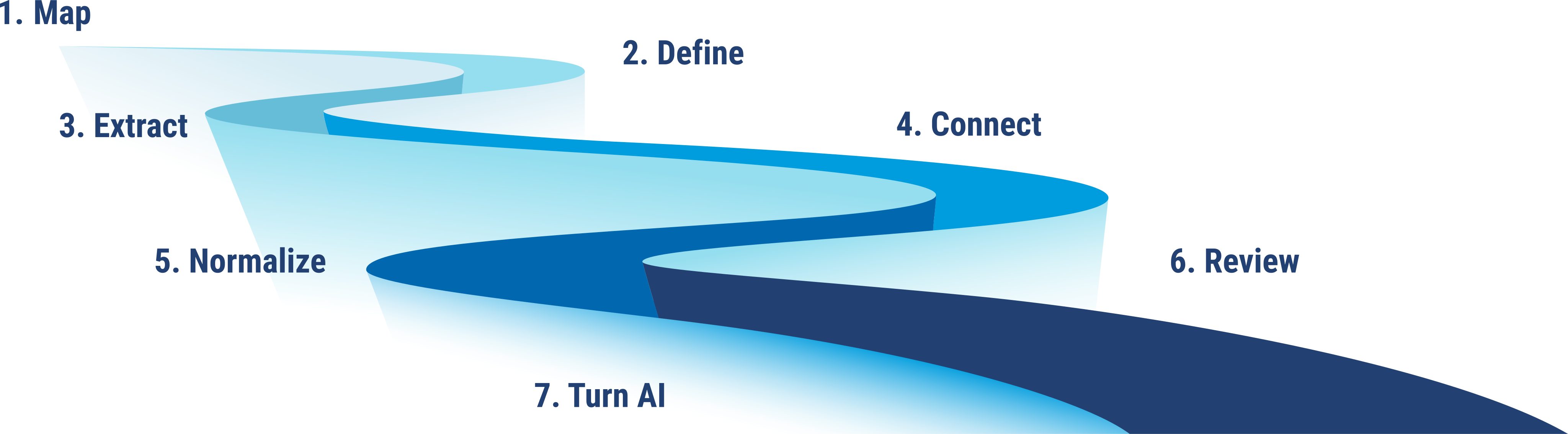
1. Map Your AI Touchpoints
Inventory every AI-enabled feature you’ve deployed or plan to use – from HubSpot’s AI assistant to your website’s search or chat utility.
Document:
- What data does it consume
- Where are the results or training logs stored?
- What role or intent it serves (lead gen, support, navigation, analytics, etc.)
This gives you a bird’s-eye view of your “AI ecosystem” and exposes where functions overlap or conflict.
2. Define Domain Ownership, Not a Single Source
nstead of declaring one vendor as the authority, assign domains of ownership:
- CMS: authoritative for public content
- CRM: authoritative for customer and engagement data
- DAM: authoritative for visual and document assets
- ERP: authoritative for inventory, pricing, or operational data
Each of these is a truth domain, but none is the truth in total.
Recognizing that frees you to orchestrate across them instead of forcing one to do it all.
3. Extract and Unify Into a Knowledge Layer You Can Use
This is where strategy becomes architecture.
Build (or commission) a knowledge layer that pulls what’s available from each system, even if it’s partial, and documents where blind spots remain.
That layer might take the form of:
- A lightweight internal data warehouse or lakehouse
- A vector-based index for semantic search
- Or a custom-built “knowledge API” that all AI agents connect to
The key is: your data stays yours, structured under your governance and able to be utilized as time progresses.
4. Connect Your AI Interfaces to That Layer
Where possible, point your AI interfaces to that knowledge backbone, and wherever vendor walls prevent it, at least document the limits. Sometimes visibility is enough to prevent duplication or bad decisions.
That ensures:
- Consistent answers you may nurture across interfaces
- Traceable citations and version control
- Easier compliance and auditing
- The ability to change vendors without losing institutional memory
5. Normalize and Monitor Intelligence
Extraction is only half the story – the other half is monitoring how it’s used.
Create a partial but actionable analytics feed, even a spreadsheet or dashboard that merges exports will do initially, so you can see the big picture across tools, without waiting for APIs that may never open up.
- What users ask for most
- Where AI tools fail to find answers
- Which queries convert, deflect, or frustrate
Normalize that data across platforms so you can make strategic, cross-vendor decisions instead of chasing five different dashboards.
6. Review Your AI Portfolio Like an Investment Plan
Once you have visibility, you can see where you’re double-paying for overlapping features.
If two or three vendors are all doing parts of the same job, quantify the opportunity cost of consolidating or building your own targeted solution.
Just like rebalancing a financial portfolio, you can trim redundancy, improve ROI, and align each tool with its true purpose.
7. Turn AI Activity Into Strategic Intelligence
Once your AI tools share a unified knowledge layer, you unlock something far more powerful than just “better answers”… you gain visibility into what your audience is actually thinking, asking, and struggling to find.
Every chatbot interaction, every AI-driven search, and every support query is a data point in an ongoing conversation between your business and its audience. When aggregated, those patterns become your roadmap for smarter marketing, UI/UX, and product decisions.
Use Search Queries as a Content Compass
Website search data is most likely one of your most underutilized strategic assets.
When AI-enhanced search tools index your content semantically, they reveal how people describe their needs in their own words. Over time, those terms and phrases:
- Expose content gaps – pages or topics users look for but can’t find.
- Reveal intent clusters – recurring themes that can inform new landing pages, guides, or product positioning.
- Highlight seasonal trends – patterns that might align with campaign planning or industry events.
In other words, search logs become an evolving editorial calendar if you know how to read them.
Use Chatbot Logs as a Feedback Engine
AI chat agents are not just service tools – they’re qualitative research at scale.
When tied to your knowledge layer, chatbot data can show:
- Which questions users keep asking despite having a page that “should” answer them.
- Where conversational handoffs to human reps occur most frequently – often your friction points.
- What emotional tone or urgency appears in common queries.
Analyzing that data quarterly can refine not only website content and FAQs, but also sales enablement and onboarding documentation.
Cross-System Intelligence Is The Real Win
When you integrate search and chat analytics within the same knowledge backbone, the insights compound:
- If users search for “installation manual” and later ask the chatbot how to install the same product, that’s a content deficiency signal.
- If “pricing” spikes in search and appears in chat sentiment logs, that may point to unclear pricing structures or missed opportunities in your lead nurture flow.
- If “return policy” appears frequently in both, your problem isn’t traffic – it’s confidence.
These are patterns that no single vendor dashboard will ever show you, because each vendor only sees its own slice. The intelligence only emerges when you unify the data.
Building the Continuous Learning Loop
This is where the idea of an “AI-enabled website” evolves into a self-optimizing ecosystem:
- Users ask = Search and chat logs capture real questions.
- AI analytics aggregates those questions into patterns.
- Marketing and content teams review the patterns quarterly.
- New or refined content is created to address the gaps.
- The knowledge layer is updated and reindexed.
- AI interfaces immediately improve as they draw from updated data.
Repeat this loop, and your site’s intelligence – and its usefulness to your audience – compounds over time.
Don’t Wait for Perfect Interoperability
One mistake I see companies make is waiting for a mythical “single pane of glass” – that one AI tool that connects every platform, normalizes every dataset, and tells the whole story.
It’s not coming any time soon, and the value you may have extracted in the meantime is too valuable to waste!
Every vendor has a reason to protect their walls, and many “integrations” are surface-deep. But you don’t need perfection to make progress.
Start small:
- Export the top 100 chatbot questions each month.
- Pull the top 100 internal searches from your website.
- Merge those lists manually and highlight overlaps.
That alone will give you a clearer view of what your audience actually wants than any vendor dashboard will.
Progress isn’t about technical perfection… it’s about clarity and ownership.
Why This Matters for 2026 and Beyond
As more vendors rush to wrap “AI” around their offerings, businesses that fail to manage their data foundations will lose control of their own narratives.
Your brand voice, your content accuracy, and even your customer experience will soon depend on how and where third-party systems train their models.
The winners won’t be the ones with the most AI features.
They’ll be the ones with a disciplined, extracted knowledge backbone that lets AI act with clarity, consistency, and context – and a process that turns usage data into strategic intelligence.
My Take
Treat your data like a portfolio of assets. Let each system do what it’s good at, but insist on one central layer that brings everything together under your governance.
Then keep a close eye on what it’s telling you because inside those AI queries and conversations lies the clearest signal you’ll ever get about what your audience actually wants.
That’s the future of digital strategy – not just connecting tools, but orchestrating truth and learning from it.
Joseph DeMicco brings over 30 years of experience to his roles as founder and CEO of Amplify Industrial Marketing + Guidance, founder of Industrial Web Search, and instructor for the Goldman Sachs 10,000 Small Businesses program, specializing in data-driven marketing strategies.