The DeMicco Digest
For each post, I use Google NotebookLM to create a podcast-style conversation between two AI hosts. I don’t script or edit their discussion, so it’s their interpretation of the article and a glimpse into what AI can do. The written post reflects my own views. How I use AI on this site
Every AI project on your company’s list sits on top of a customer database that has no owner. Fix that first, or watch the AI make the mess faster.
Somewhere in the second week of nearly every CRM migration I have been part of, the same meeting happens. Someone opens the export and finds the same customer entered seven different ways. The address fields are half empty. A column that was supposed to hold the sales rep’s name holds a mix of names, initials, and the word “house.” The person running the meeting asks a reasonable question: who owns this data?
What follows is a silence I have come to recognize. Then someone says “IT?” and the IT person shakes their head, because they keep the server running and have never been asked to decide whether “Acme Inc.” and “ACME Corporation” are the same company. Then someone says “well, everyone, really,” and that is the answer that ends the conversation, because a department is nobody, and everyone is nobody with a bigger meeting invite.
I have watched this play out for more than three decades, through three generations of CRM software, and the technology has never been the problem. The problem is that customer data in most industrial companies is an orphan. Every department touches it. No one is responsible for it. Until this year that was an expensive inconvenience. With AI it is becoming something worse, and I want to explain why before your next vendor demo.
Table Of Contents
Why this matters more now than it did two years ago
Last fall I wrote about the coming sprawl of AI features inside every tool you already pay for, and why 2026 would demand a clear source of truth. This is the ground floor of that argument. A source of truth is not a piece of software. It is a decision about which system wins when two of them disagree, and that decision requires a person with the authority to make it.
How bad is it, really
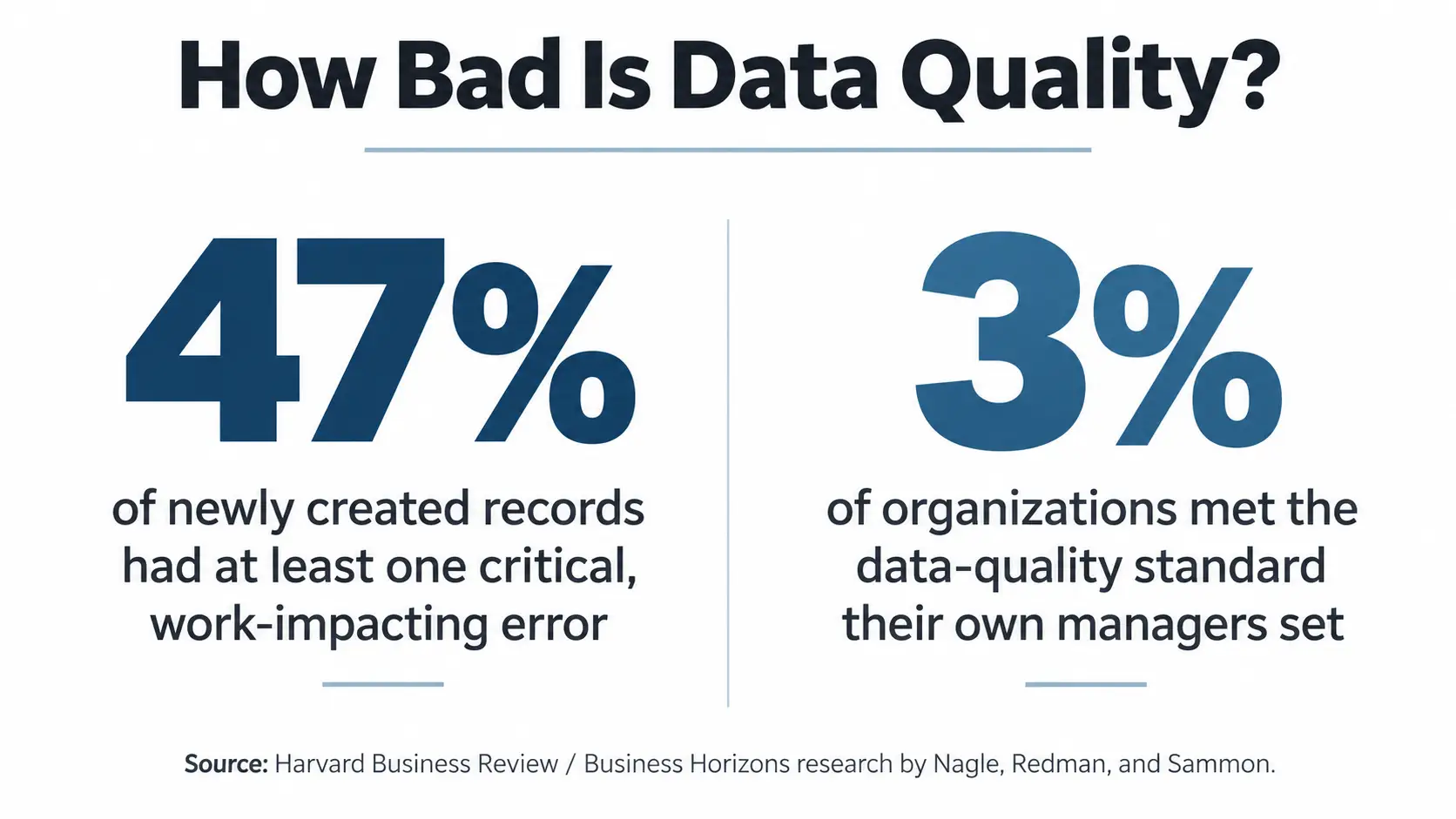
Worse than most owners believe, and there is credible research on this. In 2017, Harvard Business Review published a study by Tadhg Nagle, Thomas Redman, and David Sammon in which managers at 75 organizations audited their own records using a simple method: pull the last 100 units of work, list the 10 to 15 data attributes that matter, and mark every record with an obvious error. Before scoring, the managers agreed that anything below the high 90s would be unacceptable. On average, 47 percent of newly created records had at least one critical, work-impacting error. Only 3 percent of the organizations met the standard they had set for themselves. The authors later published the full analysis in Business Horizons, a peer-reviewed journal, with the same findings.
Gartner has estimated the cost of poor data quality at an average of $12.9 million a year per organization. I cite that figure with a caveat: it is an average across large enterprises, and it does not translate directly to a 40-person fabricator. For the companies I work with, the cost does not show up as one number. It shows up as a marketing manager spending a day a month building a list by hand because the CRM cannot be trusted to segment. It shows up as a mailing that goes to a plant that closed. It shows up as a CRM migration that was scoped at six weeks and is now in month four because every import surfaces another thousand duplicates.
How the data gets this way
None of this happens because people are careless. It happens because the systems were built one at a time, by different people, for different reasons, and nobody was ever asked to make them agree.
Several systems, none of them primary
The ERP holds the customers who have been invoiced. The CRM holds the prospects marketing has touched. Sales keeps its own spreadsheet because the CRM “doesn’t work the way we sell.” For an association, add a membership system and a learning platform. Each system is authoritative for something, and no one has written down what.
Duplicates are born at the point of entry
A rep types the company name from memory. A form submission comes in with a different spelling. An import from a trade-show list adds a third. Nothing stops any of this, because nothing was ever designed to.
Integrations inject bad data that looks official
This is the one that surprises people. When two systems are synced, errors in the upstream system flow downstream and arrive looking authoritative. A duplicate created in accounting shows up in the CRM as a clean, system-generated record. The integration is working exactly as designed. The data it carries is not.
Defaults fill in what people skip
Every CRM has fields that are required and fields that are not. The optional ones get skipped, and where a default exists, the default wins. That is how a company ends up with thousands of contacts whose lead source is “Direct” and thousands of companies whose industry is “Other.”
People leave, and their records stay
Every departure leaves behind a set of records only that person understood. Deals with no next step, contacts assigned to an owner who no longer exists, notes in shorthand. The records are still there. The knowledge that made them useful left with the badge.
What a data owner actually is
Industrial companies already run this role every day. They have just never pointed it at customer records. No one would run a machine shop without a quality manager for parts. Someone owns the tolerances, the inspection process, the decision about what gets scrapped and what ships. Customer data needs the same thing, and it needs it in a person, not a committee.
The data owner is not the IT administrator, who keeps the systems running but has no standing to decide what a good record is. It is not the CRM vendor’s implementation partner, who leaves. It is not a rotating duty. It is one person, usually in marketing or sales operations, whose accountabilities are written down and who has the authority to say no to a bad import.
Their job, in practice:
- Decide which system is the source of truth for each type of record: company, contact, deal, invoice. Write it down. When two systems disagree, the written rule wins, not the loudest person.
- Define the fields that matter and what values they are allowed to hold. Not every field. The ten or fifteen that drive segmentation, reporting, and follow-up.
- Set the entry standard and enforce it at the door: form validation, import review, a duplicate check before a record is created rather than after.
- Approve every integration, and know the direction it runs. A sync with no owner is a leak with a schedule.
- Run the monthly hygiene: duplicate rate, completeness of the key fields, records untouched in twelve months. Report it to leadership the same way the quality manager reports scrap rate.
It is a real job. In a mid-sized company, it is a fraction of one person’s week, but it must be a named fraction, in that person’s job description, with leadership behind it. The moment it becomes “something we all try to do,” you are back to everyone, which is nobody.
What to do in the next ninety days
Do this before any AI initiative, and before any CRM migration. In that order, because every one of these steps gets more expensive after the migration starts.
- Name the owner. One person, one backup, written into a job description this month. If you cannot name the person, you do not have a data strategy; you have a hope.
- Run the Friday afternoon test. Use the HBR method on your own CRM: last 100 records, the 10 to 15 fields that matter, mark the errors, score it. It takes two hours and no software. The number will be worse than you expect, and it will end the argument about whether this matters.
- Declare the system of record. For each record type, which system wins. One page. Signed by the owner and whoever runs the company.
- Define the ten fields. The ones you segment, report, and route on. Give each one an allowed set of values. “Industry” with a dropdown of twelve beats “Industry” with a free-text box of four hundred.
- Dedupe once, with a merge rule. Decide in advance which record survives a merge and what happens to the history. Then do it, once, completely. Deduping without a rule creates a different mess.
- Fix the doors. Forms, imports, and integrations are where bad data enters. Add validation, require a review step on imports, and give every sync an owner and a direction.
- Start the monthly report. Three numbers, every month, in front of leadership: duplicate rate, key-field completeness, stale records. What is reported gets better. What is assumed gets worse.

Then, and only then, the AI conversation
I am not against the AI tools your vendors are showing you. Some of them are very good. Every one of them assumes the data underneath is right, and every one of them will amplify whatever it finds. The companies that get value from AI over the next two years will not be the ones with the most sophisticated models. They will be the ones whose data a model can trust, and that is a management decision before it is a technical one.
Until someone owns the data, every AI investment downstream of it is built on sand. Name the person. Run the test. Then take the demo.
Sources & Further Reading
The following resources informed this article. All claims have been verified against multiple sources where possible.
- Nagle, Redman, Sammon, “Only 3% of Companies’ Data Meets Basic Quality Standards,” Harvard Business Review, September 11, 2017 – https://hbr.org/2017/09/only-3-of-companies-data-meets-basic-quality-standards
- Nagle, Redman, Sammon, “Assessing data quality: A managerial call to action,” Business Horizons 63(3), 2020 – https://doi.org/10.1016/j.bushor.2020.01.006
- Gartner, “How to Improve Your Data Quality” (Smarter With Gartner), 2021 – https://www.gartner.com/smarterwithgartner/how-to-improve-your-data-quality
Joe DeMicco is the Founder and President of Amplify Industrial Marketing + Guidance (AIMG), a full-service B2B industrial marketing agency with 30+ years serving manufacturers, fabricators, distributors, and trade associations. He is also the founder of Industrial Web Search (IWS), a keyword-driven B2B supplier directory platform. Joe teaches the marketing module for the Goldman Sachs 10,000 Small Businesses program and writes about AI, marketing, and B2B strategy at demicco.com.