The DeMicco Digest
Grab your headphones and enjoy a mini-podcast version of this blog. Sit back and listen while we walk you through the key points!
“You use AI now, so it should cost less.” Sometimes that is true. Here is how to tell which parts of your marketing spend should get cheaper, which should not, and what to ask.
I run an agency, so read this knowing I have a stake in the answer. I have tried to write it the way I would want an advisor to write it if I were the one across the table, because the conversation is coming whether agencies like it or not, and I would rather have it in the open.
Over the past year, I have heard some version of the same sentence from owners, CFOs, and procurement managers. “Agencies are using AI now, so it should cost less.” Sometimes it comes with a smile. Sometimes it comes attached to a renewal conversation. In more than thirty years of doing this, I have not seen a pricing question arrive with this much “certainty” behind it, and I understand why this perception can develop. The tools are visible. Everyone has used them. It is easy to assume the savings are sitting on the agency side of the table waiting to be claimed.
It is a fair question. It is also usually asked about the wrong line items.
I have written before about the fully burdened cost of an in-house team, the false comparison between a retainer and a salary, and why one talented hire cannot carry every discipline. This piece is about what happens to all of those numbers once AI enters the picture, and how a buyer should think about it.
Table Of Contents
The pressure is real, and it is not only in marketing
Promethean Research, which surveys digital agencies annually, reported in 2025 that clients are asking agencies for price reductions specifically because of AI, and that agency margins are compressing as a result. The same tension is playing out in every hours-based profession. In March, Bloomberg Law reported that the largest U.S. accounting firms are redesigning their pricing models because AI is cutting the billable hours their businesses were built on, with one PwC tax leader saying time is becoming less and less relevant. The American Institute of CPAs, whose 2025 survey of more than a thousand firms found median hourly rates still rising, recommended those firms accelerate their move away from hourly billing anyway.
I find that pretty telling. The accountants are not saying AI makes their work worth less. They are saying something closer to what I have believed for a long time: hours were always a stand-in for value, a convenient one, and AI has broken the stand-in. Marketing is no different. It just took us longer to admit it.
What AI compresses, and what it does not
McKinsey estimated in 2023 that generative AI could raise the productivity of the marketing function by an amount equal to 5 to 15 percent of total marketing spending. That is a meaningful number, and in my experience it is concentrated in specific kinds of work. A useful way to think about any agency scope is to sort it into three buckets.
Bucket | Examples | What AI does to it |
|---|---|---|
Production | First drafts, image variations, transcription, meta descriptions, resizing assets for six channels, data cleanup, reporting assembly | Compresses hours substantially. Some tasks that took a day take an hour. This is where your price should move, or your output should multiply. |
Judgment | Strategy, positioning, what not to do, campaign selection, budget allocation, knowing your buyer and your competitors | Barely touched. AI can inform judgment; it cannot be accountable for it. This is what you are actually paying for. |
Assurance | Reviewing AI output for accuracy, brand fit, technical correctness, and legal exposure; knowing when a draft is wrong | Increases. Every hour AI saves in production creates a fraction of an hour in review, and skipping it is how companies end up publishing errors under their own name. |
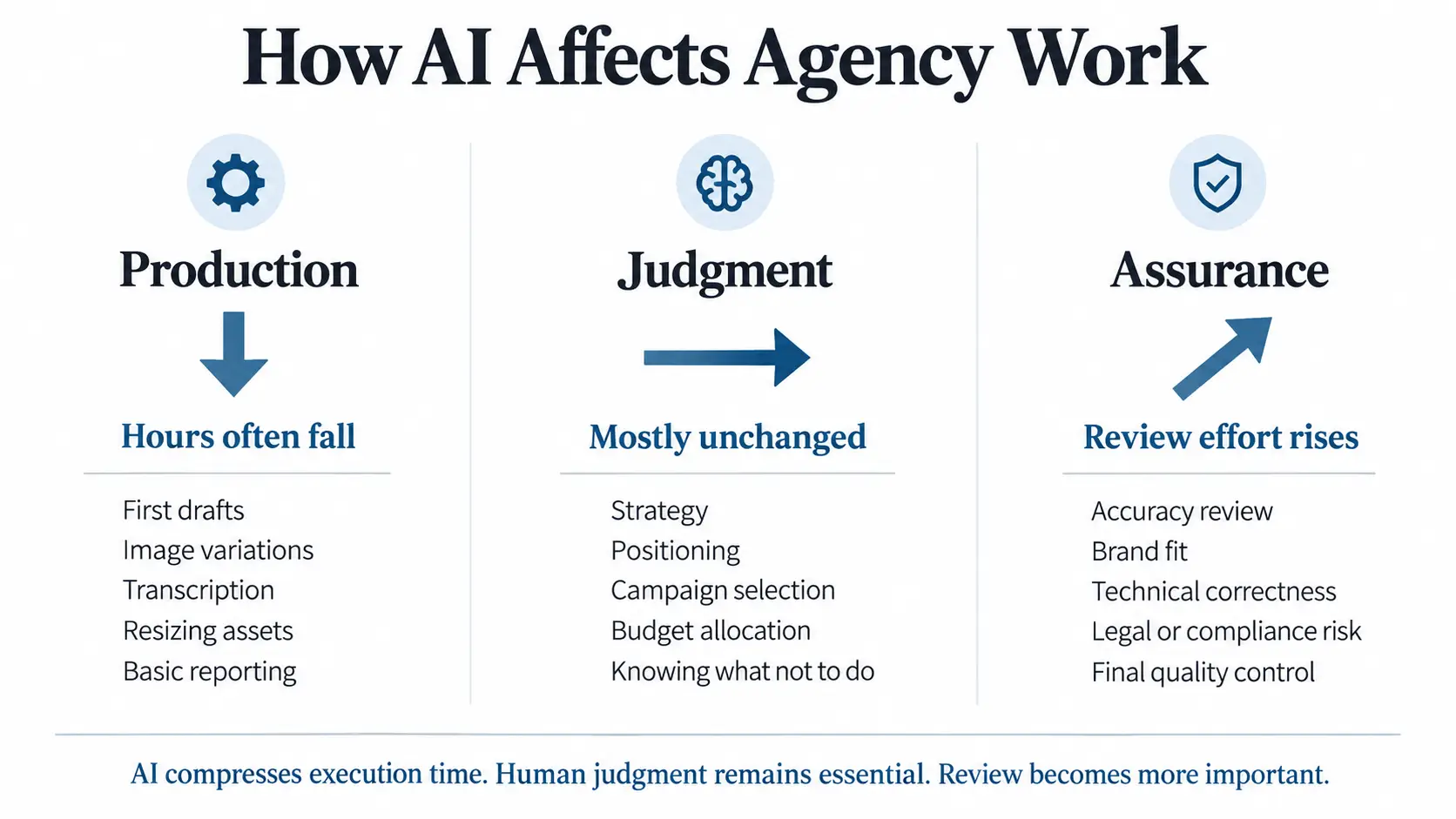
Most of the “it should cost less” pressure is aimed at the whole retainer. Most of the actual savings live in the first bucket. The second bucket has not gotten cheaper. The third has gotten more expensive, because every AI-assisted deliverable now needs a competent person to catch what the model got wrong, and in my shop that person is usually the most experienced one we have, not the least. An agency that tells you AI has made everything cheaper is either skipping the third bucket or was never doing the second one.
How your pricing model changes the conversation
Hourly billing
If your agency bills by the hour, AI creates a direct conflict of interest: the faster they work, the less they earn. Some agencies handle this honestly, and some do not. Ask how their hours per deliverable have changed over the past year. If the answer is “they haven’t,” either the agency is not using AI in production, which is a different concern, or the efficiency is being absorbed somewhere you cannot see. Hourly billing made sense when hours tracked value. For production work, they no longer do.
Retainer
A retainer buys capacity and continuity, not a specific hour count. This is where the “where did the time go” question matters most. If production hours have dropped 30 percent inside your retainer, one of three things happened: the agency delivered more within the same fee, the agency reallocated the time to judgment and assurance work, or the agency pocketed the difference. All three are possible. Only the third is a problem, and you can only tell which one occurred if you are looking at output and outcomes rather than the invoice.
The arithmetic is worth doing once. Take an illustrative $10,000 monthly retainer where roughly 40 percent of the work is production and 60 percent is judgment and assurance. If AI cuts production hours by 30 percent, that frees about 12 percent of the retainer, or $1,200 a month of capacity. That is not nothing, and it is not the 30 percent discount a procurement manager may have in mind. The right conversation is about what that $1,200 of capacity now buys you: two more pieces of content, a faster turnaround standard, an extra hour of review on every deliverable, or a credit. Any of those is a fair answer. Silence is not. I have been on the agency side of that meeting, and I can tell you the agencies that have the answer ready are the ones that have already been asking themselves the question.
Project and value-based pricing
A fixed fee for a defined outcome is the model least distorted by AI, because the buyer is paying for the result rather than the effort. The risk shifts to scope: an agency using AI well can deliver a project faster and may quote it lower, but a fixed fee also removes any incentive to spend an extra hour on assurance. If you buy this way, the quality-control question below becomes the most important one you ask.
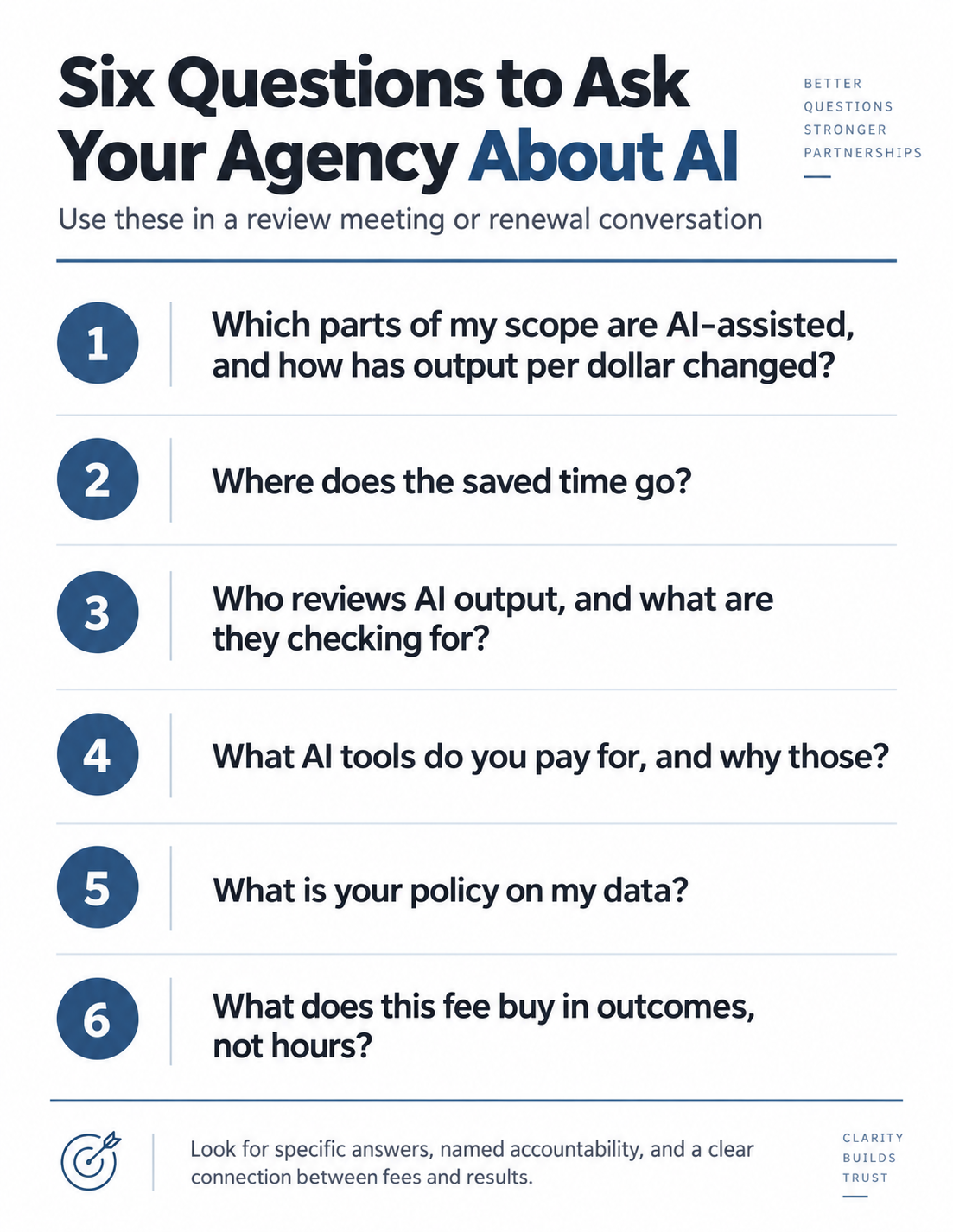
Six questions to ask your agency
Industrial companies already run this role every day. They have just never pointed it at customer records. No one would run a machine shop without a quality manager for parts. Someone owns the tolerances, the inspection process, the decision about what gets scrapped and what ships. Customer data needs the same thing, and it needs it in a person, not a committee.
The data owner is not the IT administrator, who keeps the systems running but has no standing to decide what a good record is. It is not the CRM vendor’s implementation partner, who leaves. It is not a rotating duty. It is one person, usually in marketing or sales operations, whose accountabilities are written down and who has the authority to say no to a bad import.
Their job, in practice:
- Decide which system is the source of truth for each type of record: company, contact, deal, invoice. Write it down. When two systems disagree, the written rule wins, not the loudest person.
- Define the fields that matter and what values they are allowed to hold. Not every field. The ten or fifteen that drive segmentation, reporting, and follow-up.
- Set the entry standard and enforce it at the door: form validation, import review, a duplicate check before a record is created rather than after.
- Approve every integration, and know the direction it runs. A sync with no owner is a leak with a schedule.
- Run the monthly hygiene: duplicate rate, completeness of the key fields, records untouched in twelve months. Report it to leadership the same way the quality manager reports scrap rate.
It is a real job. In a mid-sized company, it is a fraction of one person’s week, but it must be a named fraction, in that person’s job description, with leadership behind it. The moment it becomes “something we all try to do,” you are back to everyone, which is nobody.
What to do in the next ninety days
These work whether you are evaluating a new agency or reviewing the one you have. They are designed to be answered in a meeting, not in a proposal, because the quality of the answer tells you as much as the content.
- Which parts of my scope are AI-assisted, and how has your output per dollar changed? A competent agency can answer this by bucket. Vague answers about being “AI-powered” are a sign the agency is marketing AI rather than using it.
- Where does the saved time go? The right answers are more deliverables, faster turnaround, deeper strategy, or a price adjustment on production-heavy scopes. “We’re still figuring that out” is honest but should not last two quarters.
- Who reviews AI output, and what are they checking for? You want a named role, not a process diagram. Accuracy, brand voice, technical claims, and anything with legal or compliance exposure. If nobody owns this, you are the reviewer, and you are not being paid for it.
- What AI tools do you pay for, and why those? This is the question most buyers skip. I pay for the top tier of the tools we use, and I do it for the same reason a good machinist does not buy the cheapest end mill: the difference shows up in the work. The gap between free and professional tiers is real. An agency investing in better tools on your behalf is a good sign. An agency running your work through a free account is a cost you are absorbing in quality, whether or not it shows on the invoice.
- What is your policy on my data? Which of your materials, customer lists, pricing, and internal documents go into which tools, under what terms, and who inside the agency can do it. I have written separately about this, and it belongs in every agency agreement now.
- What does this fee buy in outcomes, not hours? Leads, qualified conversations, pipeline, share of voice, whatever the true measure is for your business. If the agency cannot connect the fee to an outcome, AI is not your biggest pricing problem.
Where prices should actually fall
Let me be direct, because a piece from an agency owner that never concedes the point is not worth your time. There are scopes where a buyer should expect a lower price than in 2023, and should push for it. I would.
- Production-only retainers: content volume, social scheduling, basic design variations, routine reporting. If the strategy is yours and the agency is executing, the execution has gotten cheaper, and the fee should reflect it or the volume should rise.
- Translation, transcription, and repurposing. These were labor-priced and are now largely tool-priced, with a review layer.
- First-draft anything. If you are paying for drafts rather than finished, reviewed work, you are paying for something the tools do.
Where prices should not fall is anything in the judgment bucket. Knowing which trade show to skip, which market to enter, why a campaign underperformed, and what to tell your board about it has not gotten cheaper, because the people who can do it have not gotten more numerous. If anything, AI has made that judgment more valuable, because there is now far more output competing for the same buyer’s attention and far less tolerance for getting it wrong.
The in-house comparison, revisited
Every argument here applies equally to an in-house team. AI raises the floor for a marketing department of one just as it does for an agency, and a good in-house marketer with professional tools can produce far more than they could three years ago. What AI does not do is add the disciplines that person does not have. The department-of-one problem was never volume; it was breadth. If you are weighing in-house against agency, the fair comparison is judgment and breadth against judgment and breadth, with production cost largely a wash.
A note on what I see agencies getting wrong
Some agencies cut price preemptively to keep the account, then quietly cut the assurance bucket to protect margin. You find out when something wrong gets published under your name. Others put AI in the proposal and run the same 2022 workflow behind it; question one will surface that in about a minute. Then there is the agency that treats AI as a reason to avoid the pricing conversation altogether, which usually means nobody there has done the work of figuring out where the value moved. None of this is fatal. All of it is worth a direct conversation, and how the agency reacts to that conversation will tell you more about the partnership than the proposal did.
What should you pay an agency that uses AI? What you should always have paid: a price tied to judgment and results, with production priced like the commodity it is becoming. AI did not change that principle. It made it impossible to keep ignoring, which, if I am being fair to the procurement managers, is a service they were owed.
Sources & Further Reading
The following resources informed this article. All claims have been verified against multiple sources where possible.
- Bloomberg Law, “AI Efficiency Gains Push Accounting Firms to Reimagine Pricing,” March 5, 2026 – https://news.bloomberglaw.com/financial-accounting/ai-efficiency-gains-push-accounting-firms-to-reimagine-pricing
- Promethean Research, “How AI Is Reshaping Digital Agencies” (2025 survey findings) – https://prometheanresearch.com/ (link the report or research page; the 2025 presentation is also hosted by GatherUp as a PDF)
- McKinsey, “The economic potential of generative AI: The next productivity frontier,” June 2023 – https://www.mckinsey.com/capabilities/mckinsey-digital/our-insights/the-economic-potential-of-generative-ai-the-next-productivity-frontier
Joe DeMicco is the Founder and President of Amplify Industrial Marketing + Guidance (AIMG), a full-service B2B industrial marketing agency with 30+ years serving manufacturers, fabricators, distributors, and trade associations. He is also the founder of Industrial Web Search (IWS), a keyword-driven B2B supplier directory platform. Joe teaches the marketing module for the Goldman Sachs 10,000 Small Businesses program and writes about AI, marketing, and B2B strategy at demicco.com.